Rate Cards
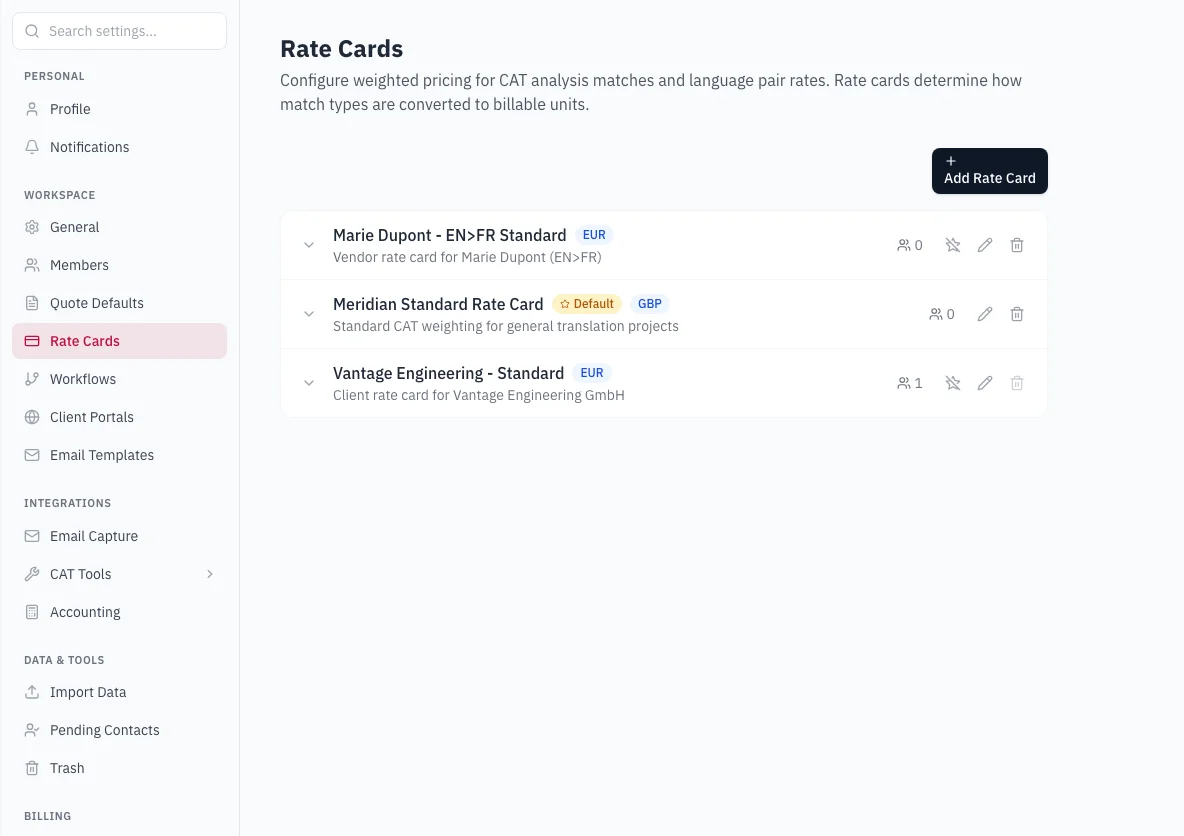
Client and vendor rate cards with per-language, per-tier pricing. Set it once, apply it everywhere.
CAT Tier Pricing
Define rates for each fuzzy match tier — from new words to exact matches. Weighted pricing calculates automatically on quotes.
Client-Specific Cards
Each client can have their own rate card. Negotiated rates apply automatically when you build quotes for that client.
Vendor Rate Cards
Track what each translator charges per language pair and tier. Compare vendor costs against client rates instantly.
Weight Adjustments
Apply discount weights to high-match tiers. 100% matches at 30% of the new-word rate? Set it once, apply it to every quote.
Keep the rates you've agreed in one place
Translation rates have a habit of ending up everywhere.
One client has a spreadsheet. Another has rates buried in an old quote. A translator emailed a new price six months ago. Someone remembers the legal rate is different but isn't entirely sure where it was written down.
VectorLingo gives clients and vendors their own rate cards, with rates stored by language pair and CAT match tier.
Once they're there, you can use them when quoting clients and costing vendor work rather than looking them up again for every project.
And when a rate changes, you update the rate card instead of chasing down every place the old number might still be sitting.
Built for CAT pricing
Translation pricing isn't always just “words × rate”.
If you work with CAT analysis, you may charge differently for new words, repetitions, fuzzy matches and exact matches. Vendor pricing may follow a similar structure without necessarily being identical to the client’s.
VectorLingo lets you store those rates by match tier and use weighting where that’s how you price the work.
So when an analysis comes in from Phrase or Trados, the commercial calculation can follow the same structure rather than flattening everything into a single word count.
You're still in control of the pricing. VectorLingo doesn't tell you what a fuzzy match should cost or how much discount to apply. It gives you somewhere to define your own rules and reuse them.
Client rates on one side, vendor costs on the other
Client pricing only tells you half the story.
VectorLingo keeps vendor rates too, so when you're building a quote you can see what you expect to charge alongside what you expect the work to cost.
That becomes particularly useful when rates change at different times. A client's pricing may have stayed the same while your translators' rates have gone up. Without both sides visible, it's easy for that difference to disappear inside the job.
The rate cards feed into the rest of the system rather than sitting there as reference data. Client rates can be used in quotes and vendor rates in costing.
If a particular job needs different pricing, you can still override it without changing your usual rate.
Useful if your pricing is actually complicated
If you charge the same flat rate for nearly everything, you probably don't need much of this.
Rate cards become more useful when prices vary by client, vendor, language pair or CAT match tier — especially when the same rates need to turn up again in quotes and project costs.
That's what VectorLingo is built around.
The rate card holds the usual commercial agreement. The job can still be the exception.
Frequently asked questions
Can every client have their own rate card?
Yes. Client-specific rate cards can hold the pricing you’ve agreed with that client and feed those rates into quotes.
How does fuzzy-match pricing work?
You can store different pricing across CAT match tiers and apply weighting where that's part of your pricing model.
Can I store translator rates too?
Yes. Vendors can have their own rate cards by language pair and match tier.
Can I change the rate for a single job?
Yes. You can adjust an individual quote or cost line without changing the normal rate card.
Ready to try Rate Cards?
Start your free trial today. No credit card required.
Start Agency trial→