Quote Builder with CAT Analysis
Build multi-language quotes with fuzzy match breakdowns, per-tier rates, and instant margin preview. Your clients see a professional quote; you see your profit.
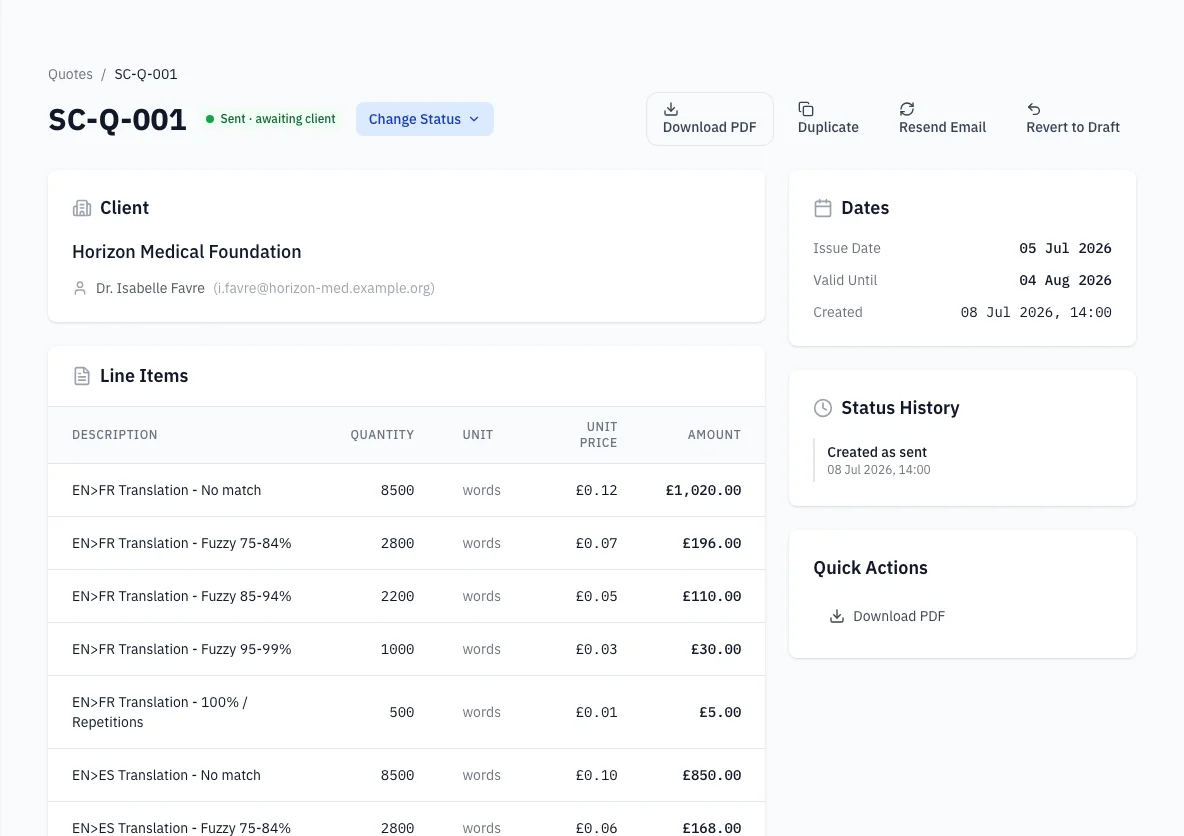
CAT Analysis Import
Import Phrase TMS or Trados analysis files. Fuzzy match tiers break down automatically.
Multi-Language Pricing
Set different rates per language pair and match tier. Price each target language independently based on complexity and volume.
Instant Margin Preview
See your projected margin before sending. Compare client rates against vendor costs to ensure every quote is profitable.
One-Click Convert to Project
Client accepts? Convert to a project with pre-populated workflow, language pairs, and scope lines carried over automatically.
Quote from your CAT analysis, not a spreadsheet
If you already have the word counts in Phrase or Trados, you shouldn't have to rebuild them in a spreadsheet just to produce a quote.
Import the CAT analysis into VectorLingo and the match bands are brought into the quote for you: new words, repetitions, fuzzy matches, exact matches and the other categories in the analysis.
From there, you apply your client rates and build the commercial side of the job around the same numbers your production team will use later.
It means less copying between systems, but also fewer opportunities for the quote and the CAT analysis to drift apart.
VectorLingo doesn't replace your CAT tool. Phrase or Trados still does the analysis and translation work. VectorLingo uses that data for quoting, costing and project management.
Price each language properly
Multilingual projects rarely fit neatly into one rate.
Your EN→DE pricing may be completely different from EN→JA. One client may have negotiated rates for certain language pairs. Another job may need an exception because of the subject matter or turnaround.
VectorLingo lets you price each language pair separately, including different rates across CAT match tiers.
Your usual rates can come straight from the client's rate card, so you're not entering the same numbers every time you quote. If a particular job needs different pricing, you can change the individual line without changing the underlying rate card.
That gives you a quote you can actually inspect rather than a single total hiding everything underneath it.
Know what the quote is worth before you send it
A quote can look healthy at the top and still be poor business underneath.
VectorLingo shows the projected margin while you're building it, using the client price and expected vendor cost behind each line.
If one language is dragging the margin down, you can see where the problem is before the quote goes out. Maybe the vendor cost is high. Maybe the client rate hasn't moved for years. Maybe you're happy with the margin anyway.
VectorLingo doesn't make that decision for you. It simply puts the numbers together while you still have the chance to change them.
From accepted quote to live project
Once a client accepts, you don't need to create the same job again from scratch.
The language pairs, scope and workflow from the quote carry into the project, giving the project manager a starting point based on what was actually sold.
That connection is particularly useful when quotes get more complicated. A five-language job with several services is much easier to hand over when the project structure already reflects the quote the client accepted.
Frequently asked questions
Does the quote builder work with Phrase TMS and Trados?
Yes. You can import CAT analysis data from Phrase or Trados and use its match tiers in the quote. VectorLingo works alongside your CAT tool rather than replacing it.
Can I use different rates for different languages and match tiers?
Yes. Rates can vary by language pair and CAT match tier. Your normal rates can come from a rate card, with individual lines adjusted when necessary.
Can I see the margin before sending a quote?
Yes. VectorLingo compares the client price with the expected vendor cost and shows the projected margin while you build the quote.
What happens when the client accepts?
The accepted quote becomes the basis of the project, including its languages, scope and workflow.
Ready to try Quote Builder with CAT Analysis?
Start your free trial today. No credit card required.
Start Agency trial→